


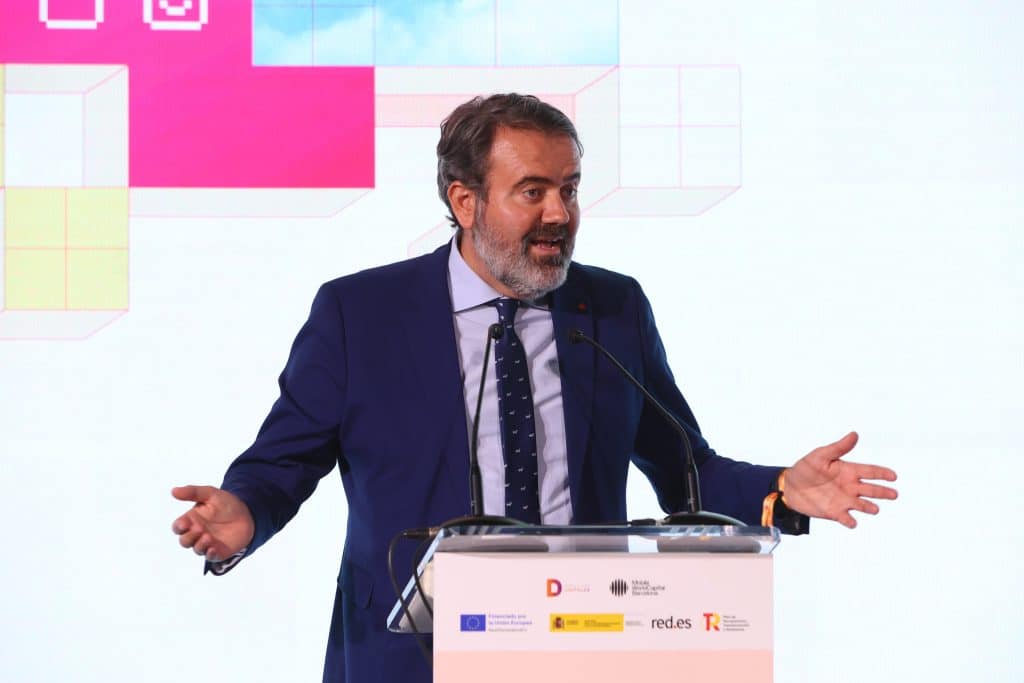
Rubén Pérez Correa closed the first day of the International Meeting on Digital Rights by emphasizing that “if minors are going to be on social media, today’s platforms are not good enough.”
The first day of the meeting featured internationally renowned figures in technology, such as former Facebook executive Yaël Eisenstat and journalist Cory Doctorow, who analyzed the challenges of today’s digital landscape.
Minister Óscar López will open the second and final day of the meeting, which will include international experts such as Giuliano da Empoli (The Wizard of the Kremlin), Carl Öhman, and Frances Haugen.
The Secretary of State for Youth and Children, Rubén Pérez Correa, closed the first day of the 1st International Meeting on Digital Rights, held in Barcelona, with a speech in which he emphasized the need to establish “constant dialogue with the technology sector in order to create tools that protect minors’ digital rights.”
In this regard, he stressed that “a great deal is at stake in the definition of digital rights and in how we guarantee the protection of minors in this field.” He also argued that “if minors are going to be on social media, today’s platforms are not good enough.” Finally, Pérez Correa recalled that the commitment to regulating digital spaces “does not mean avoiding critical thinking or limiting innovation.”
The Secretary of State for Youth and Children closed the first day of this meeting, organized by the Government of Spain and Mobile World Capital within the framework of the Digital Rights Observatory. The event also featured a video message from the Prime Minister, Pedro Sánchez, in which he highlighted Barcelona’s role as the “world capital of digital rights.”
The Secretary of State for Digitalization and Artificial Intelligence, María González Veracruz; the Minister of Economy and Finance of the Government of Catalonia, Alícia Romero; and the Barcelona City Councillor for Economy, Housing, Finance and Tourism, Jordi Valls, took part in the institutional opening of the meeting, which brings together some of the most influential global voices in technology, ethics, and governance with a fundamental objective: to debate, in a clear and accessible way, the current challenges involved in achieving a fairer, safer, and more responsible digital environment.
Yael Eisenstat, Cory Doctorow and Anu Bradford, keynote speakers of the day
During this first day, the main stage at La Llotja de Mar in Barcelona hosted figures such as Yaël Eisenstat, technology policy expert and former Facebook executive. Eisenstat focused on the impact of algorithms and social media on democracy and disinformation. She also emphasized the urgency of regulatory measures requiring major platforms to be more transparent.
Cory Doctorow also took part in the event. One of the leading international voices in technology journalism and author of Enshittification, he explored the challenges of the digital rights agenda and the role of major technology companies in shaping the present.
“What we now call ‘enshittification’ describes a process in which users become trapped in platforms that, over time, degrade the user experience while intensifying value extraction. In response to this model, we advocate building an open and transparent internet where people can regain control and trust in the digital environment,” Doctorow explained.
For her part, Anu Bradford, Professor of Law and International Organizations, analyzed the European Union’s regulatory policies within today’s fragmented geopolitical landscape. Bradford stressed that “in a context of declining freedoms and intense global technological competition, it is crucial to commit to a third path based on rights. It is not about choosing between the United States or China, but about promoting a model in which innovation and fundamental rights go hand in hand, with companies, leaders, and active citizens acting as drivers of change.”
Within this framework, the Professor of Law and International Organizations referred to the “Brussels Effect,” which “reflects the European Union’s ability to influence global standards by requiring compliance with its regulations as a condition for access to one of the largest markets in the world.”

First survey on the social perception of digital rights
The event also served as the setting for the presentation of the results of the first major survey conducted in Spain on the social perception of digital rights, based on 2,500 interviews carried out by Fundación La Caixa and Fundación Hermes, in collaboration with the University of Barcelona. The presentation, which featured María González Veracruz, Secretary of State for Digitalization and Artificial Intelligence, revealed figures such as the fact that 69% of citizens consider the protection of digital rights in Spain to be insufficient.
Throughout the day, several debates were held at the Speaker’s Corner on topics such as the spread of fake news and disinformation in an environment shaped by the emergence of AI, as well as the potential of digital technologies to support the ecological transition, while also considering the impact of their environmental footprint. The space featured prominent speakers such as Tomás de la Quadra-Salcedo, former Minister of Justice and Territorial Administration, and Joan Subirats, Professor of Political Science at the Autonomous University of Barcelona (UAB) and former Minister of Universities.
Minister Óscar López opens the second day
The International Meeting on Digital Rights will continue tomorrow with the participation of Óscar López, Minister for Digital Transformation and Public Administration. Together with renowned philosopher Carissa Véliz, he will address the ethical and political challenges posed by the massive use of data in today’s democracies.
Giuliano da Empoli, president of the Volta think tank and author of the bestseller The Wizard of the Kremlin; Carl Öhman, researcher and specialist in digital legacy; Frances Haugen, data expert and whistleblower behind the publication of the so-called “Facebook Papers”; and actress and director Leticia Dolera will be among the featured figures on this second day, which will place special emphasis on the digital protection of children and young people.