


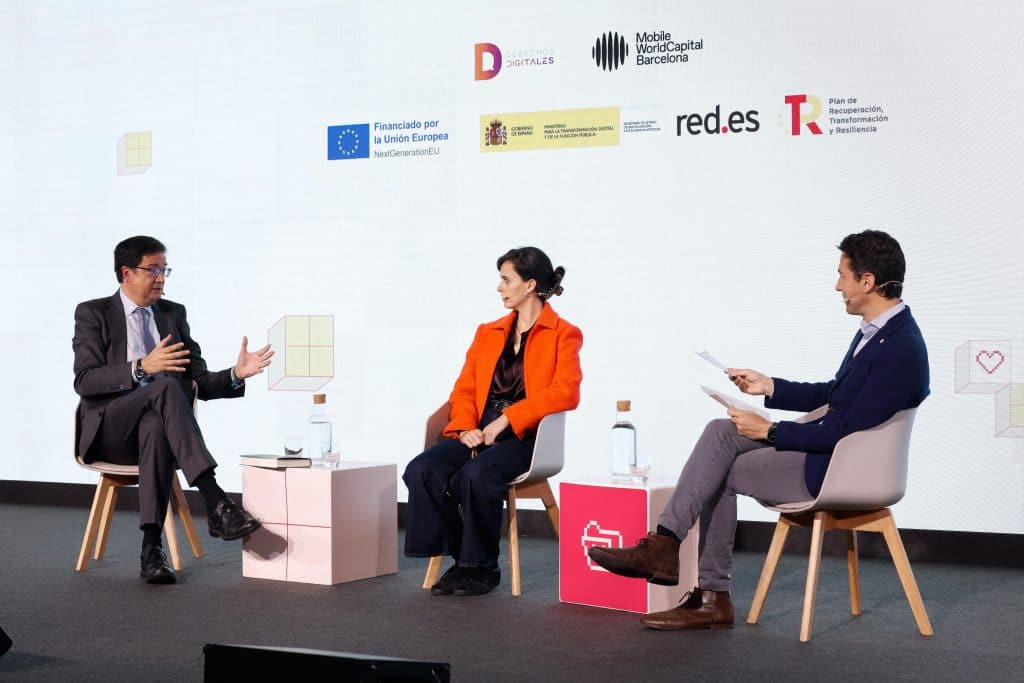
The Minister for Digital Transformation and Public Administration spoke with Carissa Véliz — philosopher, University of Oxford professor, and author of Privacy Is Power — at the 1st International Meeting on Digital Rights, held in Barcelona.
Either we do something together with the middle powers, or the Global South will become a battery and a database that will only increase the profits of five powerful actors,” López warned.
The minister argued that the debate on digital rights “is not a technological discussion, but a major political debate.”
The Minister for Digital Transformation and Public Administration, Óscar López, defended an alliance with middle powers, describing them as “countries around the world that must play a role in defining a third technological path and building trustworthy AI, which must be the future.” He made these remarks on Thursday in Barcelona during the 1st International Meeting on Digital Rights, where he spoke with University of Oxford professor and author of Privacy Is Power, Carissa Véliz. Together, they discussed the present and future of social media and Artificial Intelligence, particularly the need for global governance.
During the conversation, López stated that “the world cannot continue on life support after discovering that an AI has uncovered vulnerabilities in the financial system.” “I am convinced that either we do something together with the middle powers, or the Global South will become a battery and a database that will only increase the fortunes of five powerful actors.”
The minister argued that the debate on digital rights “is not a technological discussion, but a major political debate.” “We are discussing sovereignty. We are here to debate democracy and rights. Should digital rights exist or not? Who should define and govern them?” he asked. In this regard, López emphasized that “Spain is being a strong voice” in calling for the regulation of AI and social media.
The minister also stated that the conversation concerns “power concentrated in very few hands that is shaping the future model of energy, education, defense, and data privacy.” “If this were not a political issue, if it were not about power, then all Spanish users of a messaging platform would not have received a message from the owner of that network attacking the Prime Minister,” he explained. “I am here to defend a trustworthy model, one that does not put democracy, the ecological transition, the health of our sons and daughters, or national security at risk. This is not just about regulation — it is about much more than that,” he insisted.

“Those of us working on AI governance, the more we learn, the more radicalized we become in the awareness that we are already late,” López continued, arguing that this is “an entirely civilizational issue.” Drawing a parallel with the 2008 financial crisis and how deregulation caused financial products to “spin out of control,” the minister called for action “before it is too late.” “I do not want a future in which, during trials about what happened with social media and AI, engineers appear saying that things also got out of hand,” he stated, recalling that “banking regulation has not harmed competitiveness” and that “the same could happen with AI.”
For this reason, he stressed that “there is much to be done” at both the international and European levels, but that Spain is already moving forward with initiatives such as the Digital Rights Charter, the Digital Rights Observatory, legislation establishing a minimum age for the use of social media, and support for the European AI Regulation, where the Government succeeded in including a ban on systems enabling sexual deepfakes. “We are taking steps in both regulation and innovation. It is not only about setting rules, but also about investing in ethical tools and building not the fastest or the cheapest AI model, but the most trustworthy one. Spain will fight on every front to ensure that this becomes reality,” he added.
López also emphasized the importance of implementing “elements that allow us to maintain sovereignty,” recalling that the Government has allocated more than €30 billion to chip and semiconductor factories, leading companies working on AI language model comprehension, and to “flooding” Spanish universities with AI, cybersecurity, and data management chairs.
In addition, he noted that Spain is acting on other fronts, such as regulating the construction of data centers through a recently approved decree that “establishes sustainability requirements and combats speculation.” He also highlighted the country’s commitment to supercomputing, public investment in globally leading AI SMEs “to keep them rooted in the country and prevent them from being absorbed by large tech corporations,” and stated that Spain will host one of Europe’s first gigafactories. “We understand the risks and we are taking action. The direction and the commitment are clear,” he asserted.
In this regard, López recalled that the objective set by the Prime Minister was “to achieve with digital transformation what we have achieved with the energy transition, where Spain is a global leader in renewable energy and in building an industrial model whose energy system is exported to half the world.”

Impact of predictive AI
For her part, philosopher Carissa Véliz warned about the role of technological predictions in decision-making: “We obey predictions as if they were disguised orders, and instead of questioning them, we simply comply.” In this regard, she criticized the apocalyptic visions promoted by certain actors in the technology sector, whom she accused of “selling an idea of the future in which they present themselves as saviors.” Véliz stated that the way AI has been designed “through machine learning means learning from the past, which is why it is so sexist and racist, but we also know that part of the future is not based on the past.”
The meeting highlighted the urgency of addressing Artificial Intelligence from an ethical, political, and social perspective, avoiding both technopessimism and naïve optimism. In the minister’s words, “we understand the risks and we are taking action,” while Véliz concluded by emphasizing the importance of being “on the right side of history, rather than worrying about whether you are going to win or not,” ending her speech with a call to action: “If we are brave now, we can change course and build a better future.”
Véliz agreed with Óscar López in arguing that “today we are not fighting a technological battle, but a battle for power,” and expressed surprise that, as a society, “we are handing over our data to the least trustworthy companies in the world.”
The conversation between Óscar López and Carissa Véliz took place after the opening speech by Enrique Goñi, president of Fundación Hermes, who highlighted the tremendous effort made by the 150 organizations that, together with the 20 entities of the Digital Rights Observatory, brought three years of work to a close with the event held in Barcelona.
“Our digital lives cannot be delegated,” Goñi stated regarding the crucial and rapidly changing moment society is currently facing. “If we delegate them, we are delegating our freedom and civil rights. Technology can be a wonderful Angora cat or a tiger that may devour us,” he explained.
“What we are seeing at this Meeting shows that we are capable of anything,” Enrique Goñi said hopefully. “The match is still open; it has not yet been played. Europe has to play it, and it must do so from an ethical perspective and by promoting its own large-scale industry, without any inferiority complex.”